
Wishful Thinking About Critical Thinking


Here’s a pseudo-paradox about critical thinking: the more readily you believe in it (and the accompanying presumption that it’s only really acquired through formal education), the less of it you do, probably. Maybe that’s kind of nonsensical, but I’ve never fully understood how students/parents view the function of universities as a mechanism for labor market signaling throughout their educational journey, yet somehow this charade about critical thinking is undying. For decades, higher ed (and particularly the humanities) have been insulated from jeopardy by these enduring canards about critical thinking and the adjacent notion that they’re (higher ed, especially the humanities) unique vehicles for reshaping people’s brains and imbuing them with the ability to think well. Even now, with the long-term downsides of our top-heavy educational setup crystallizing into focus and the economic payout—an onramp to the salaried white-collar job market—plainly imperiled, this fairytale about critical thinking is still marshaled in defense of these vampiric institutions.
This Critical Thinking Hypothesis (CTH) should invite second-guessing of flimsy-yet-popular beliefs like the CTH itself, rather than the uncritical endorsement we observe. Is “critical thinking” even really a defensible concept that’s separable from stuff like reasoning, rationality, intelligence, and so on? Is critically thinking about something truly and markedly different from rationally analyzing it? Presumably, critical thinking is never irrational, unintelligent, etc., but even supposing that it’s some distinctive suite of mental powers, can/do universities really imbue students with those capabilities (let alone do so with such unique efficacy that it justifies society’s ultra-pricey higher ed outlays)?
Consider how plainly CTH fails to square with reality. For example, it’s at odds with weighty evidence that educational wage premia largely result from signaling effects rather than the accrual of human capital. And as I’ve argued before, the tradition of universities fastidiously sorting applicants by cognitive skill would be totally nonsensical and backward if their true function were to seriously modify student brainpower. If universities could really “teach you how to think,” then they wouldn’t ruthlessly preselect for skillful thinkers.
A mere coup d’oeil at stuff like LSAT scores is discouraging for CTH, too. LSATs should function decently as a measure of critical thinking skills because they test people’s reading comprehension, capacity to break down arguments and locate their weaknesses/vulnerabilities, etc. The LSAT’s makeup has been altered a few times in recent years, but here’s a logical reasoning sample question:
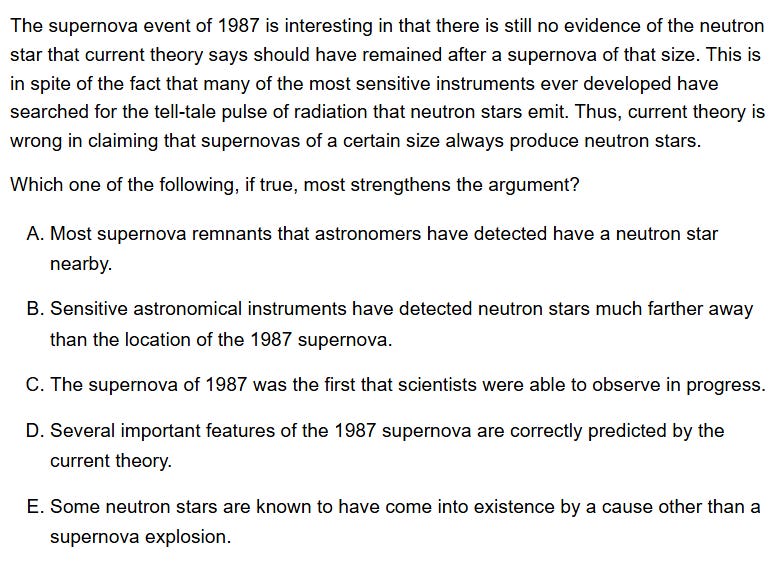
So, it’s designed for detecting things that should fall squarely within the domain of critical thinking, and per CTH (which is often used to defend the less economically advantageous sections of academia), the non-STEM crowd should excel here and outpace their more hireable counterparts, but actually the results conform much better to an IQ-blackpill/education-as-signaling outlook, and high-scoring physics majors comfortably outperform the literature and sociology students, even in something like the LSAT. Moreover, the STEM fields do well even though they’re at a huge sampling disadvantage because they have larger opportunity costs (the smartest history and lit majors often go to law school, whereas ingenious STEM grads probably don’t). Yet, CTH apologists are unimpressed by all these points:
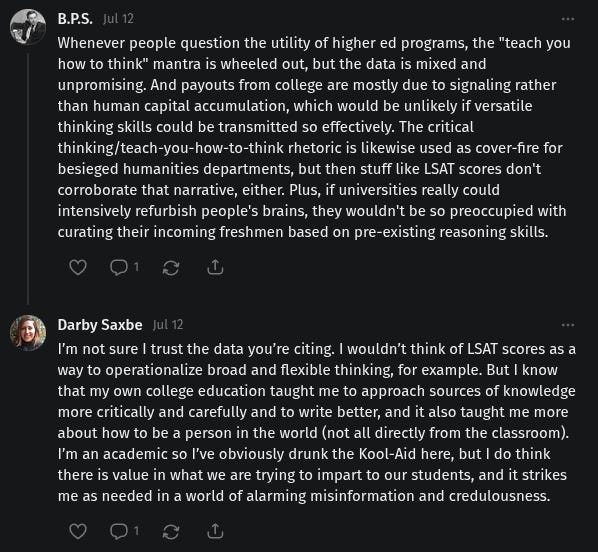
This kind of response is tellingly unpersuasive, and it’s troubling that the self-appointed mandarins of critical thinking like Darby Saxbe are so shorthanded in the very skillset they’re peddling. Obviously, whether critical thinking is crucial for the betterment of civilization moving forward is orthogonal to how teachable it is or whether universities/professors are specially equipped to achieve that conveyance. Clearly, Saxbe misjudged how effectively her own education inculcated these skills, if she thinks noteworthy data and straightforward reasoning can rightly be summarily dismissed by self-admitted Kool-Aid-drinkers on the strength of their own biased self-evaluation. Hell, if equipping someone with critical thinking abilities doesn’t inoculate folks against drunk-on-the-Kool-Aid opinionating, then what the fuck is it good for? Either this shows that universities are catastrophically imperfect in fostering critical thinking or that the style of reasoning being championed under the aegis of critical thinking encompasses pernicious intellectual habits and its proliferation isn’t obviously desirable.
Another reason we can comfortably reject CTH is that it requires a kind of magical epiphenomenalism: to provide a satisfying defense of the outlandish financial backing and outsized attention that universities receive (despite the tradition being so impractical), critical thinking must be hugely potent, valuable, and rewarding—vital for civilization well-being, reportedly—but it also has to be somehow too opaque or subtle to be easily detected by making its possessors noticeably more skillful/employable. Put differently, if critical thinking were something manifestly useful like superior reasoning, the capacity to forge arguments, or the power to formulate more accurate beliefs about the world, then it wouldn’t be so economically inert.
If studying medieval literature or whatever really were a peerless inroad for “teaching someone how to think” (it’s presupposed that all of the most seemingly useless majors are superior at this), then graduates from these superficially pointless disciplines would easily reap direct material benefits, rather than eternally battle unmet debt burdens and continually suffer mockery and derision for their quixotic choices about what to study. And while sometimes this teach-you-how-to-think chestnut is used to defend anything non-STEM, other times it’s used in defense of all post-secondary education, or occasionally to justify facets of US legal education, and this plasticity is suspicious—why is it that whatever educational program is taking heat just so happens to be the exclusive means of cultivating this vital-but-slippery brainpower?
What CTH advocates are actually doing is intellectual sleight of hand, furtively swapping out conceptual elusiveness for empirical elusiveness. But something being vaguely defined doesn’t necessarily insulate it from observation: even if the exact contours of critical thinking are fuzzy, it must have some recognizable shape to be a serviceable justification for higher ed, and it presumably includes a mixture of incredibly desirable mental capacities that would be seen as useful in the workplace (N.B., I’m probably recycling points made by Bryan Caplan here, whose overview of direct evidence about this line of argument is helpful).1
Another version of critical thinking propaganda characterizes it as the power to assess the potency and reliability of evidence—to identify misinformation, etc., but per Dan Williams’ argument that people can’t be inoculated against misinformation this way, it’s unclear whether that’s a doable mission, either. More broadly, it’s worth questioning whether highly educated folks really form more accurate beliefs and modify their behaviors accordingly, or if their cognitive advantage is mostly weaponized to backfill rationalizations of their pre-existing worldviews.
I have other reservations about the potential drawbacks of CTH too, beyond the ruination of society by an overinflated higher ed industry that shields itself behind a bogus raison d’etre; like, what if this feelgood myth really just infuses graduates like Saxbe with a misplaced, cocksure self-estimation of their own critical-thinking abilities? Do we really want the world overrun with people unfurling degrees and settling debates via a resume-measuring contest or presuming they need to “do their own research” about topics to properly formulate opinions using their critical thinking skills? I’ve made similar points before about the misguided push for scientific literacy:
if you know any engineers, for example—well, they’re not renowned for their humility. So I’d actually worry that pumping out more STEM degrees, by giving people enough rope to hang themselves, could spawn an uptick in the most insufferable kind of epistemic hubris and do-your-own-research numskulls out there. We don't need a bunch of former STEM undergrads roaming the internet, thinking they’re Emily Oster or something, and digging through COVID data to decode things for themselves using their newfound “scientific literacy.
Moreover, if universities really are a unique tool for cognitive betterment and actually “teach you how to think”, should we then classify non-college-goers as unthinking? The notion that so many years of education preceding college are inalterably ineffective at equipping students with the ability to think is depressing, but the idea that this potential suddenly reverses at university is even stranger. People wonder how tuition rates can be so gargantuan and the ongoing class warfare so bitter, but it’s all unsurprising if the very capacity to reason is presumed to be divisible along educational credentials. In modern times, with class being mediated through educational background and higher ed’s sluggish labor market coordination routine devouring society, academicians insisting they possess a monopoly on legitimate thinking is unhelpful and obnoxious.
Still, the main issue with CTH—aside from its conceptual superfluousness, its incompatibility with established features of the world, and the shortage of persuasive evidence that universities are ideally suited for cultivating critical thinking among their students—is that it doesn’t even succeed in its chief objective of explaining why, for example, non-STEM programs are so important despite being so impractical. Instead, CTH tries arguing that non-STEM programs secretly really are useful, but if so, then critical thinking should have economic and cultural payouts that it plainly lacks (or else the need for mustering critical-thinking-style defenses wouldn’t persist), and nothing about CTH explains how it’s simultaneously so crucial and so economically invisible.
Deep down, everyone must understand that CTH is bullshit, somehow, because it’s not like people actually venerate college grads like they wield some impressive acumen for critical thinking, which is understandable, given that college-going English majors can’t even understand the (admittedly abstruse) opening pages of Bleak House, but then the notion they’re being successfully kitted out with critical thinking skills is implausible. Again, if folks genuinely subscribed to CTH, employers would be scrambling to hire the psych majors that professors like Saxbe furnish with such indispensable faculties, but instead it’s the business school crowd, the engineers and the mathematicians who find jobs; it’s the doctors and astrophysicists who are specially regarded by the larger public for their mental prowess, and so on. At bottom, no one actually buys it.
So, if the project of conferring aptitude through education has been a fool’s errand (given how the human capital theory of higher ed is largely bogus), why is this particular subspecies of reasoning still widely presumed to be especially teachable? Credulity about CTH is unwarranted, but its proponents cosign the theory in a supremely uncritical fashion, seemingly exempting the outlook from scrutiny altogether, but then if this critical thinking angle really is bullshit, I guess the absence of appropriate skepticism among the putative gurus is fitting.
See Caplan, Bryan. The Case Against Education: Why the Education System Is a Waste of Time and Money 50 (2018) (studies about learning-how-to-think seem like a complicated and mixed bag, but Caplan characterizes it doubtfully).
Great post. The one epsitemic skill that really can be taught, and is in fact taught by the rare great teacher, is humility.
Thank you for featuring me so prominently in the piece, but I'm a little confused that entire argument seems to revolve around my inability to do critical thinking and yet your only evidence for that claim is one flippant response I posted in reply to a single Substack comment thread. Wouldn't you need to evaluate more evidence in order to arrive at an appropriate judgement of someone's critical thinking abilities? I'd be glad to send you some of my scholarly papers.